
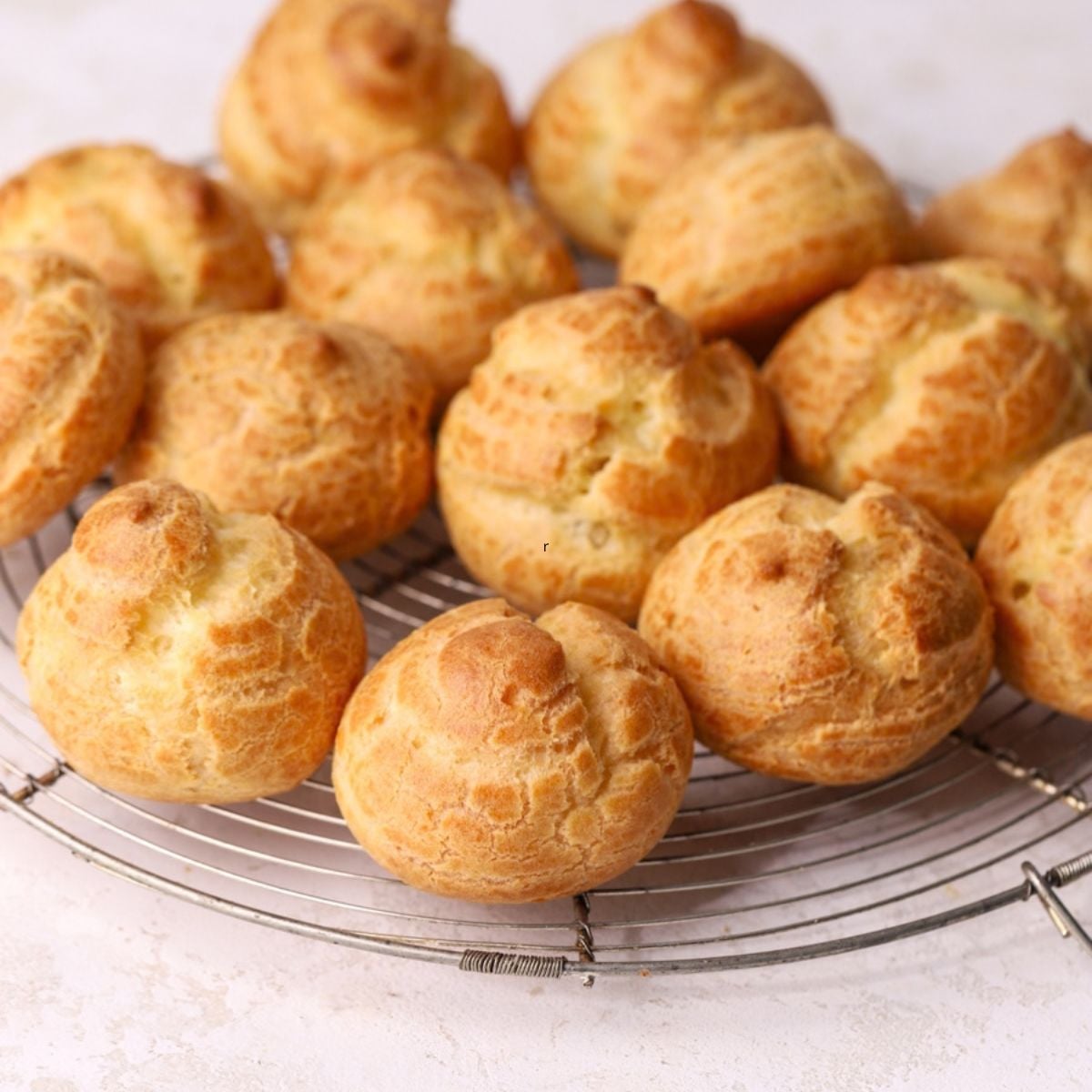
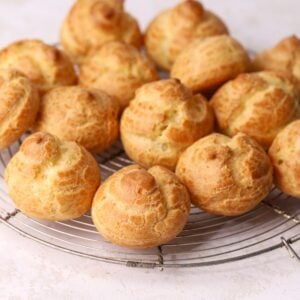
This classic French choux pastry bakes up puffy and golden with a hollow center, and you only need 7 simple ingredients. Use the dough to make cream puffs, éclairs, Paris-Brest, and so much more!
I’m including step-by-step photos plus all the tips I learned in pastry school in this guide! Be sure to explore my other pastry recipes for even more baking inspiration!
Would you like to save this?
Choux pastry (pronounced “shoo”) sounds fancy, but it’s easier than you’d think!
I learned how to make choux pastry as a pastry student at Le Cordon Bleu. We started with choux with craquelin, then made these amazing cream puffs filled with pastry cream and chantilly, then made éclairs, Paris-Brest, religieuses, and even croquembouche! 😍
The chefs would demonstrate each recipe, then we tried it ourselves. We made choux so many times that I picked up all the little tricks.
This is the second recipe I’ve shared that was inspired by pastry school. The first was my French apple tart, which has the most delicious stewed apples that I just had to share.
What Is Choux Pastry?
Choux pastry, also called pâte à choux, is the name for the dough itself, not a specific dessert. It’s a French pastry dough you can use to make many different desserts depending on how you pipe it and what you fill it with.
Choux bakes up crisp and airy. It’s hollow inside, which makes it the perfect little container for cream and more. The dough itself is mild and not very sweet. The filling provides most of the flavor, so you can use the dough for both sweet and savory recipes.
Choux pastry is different from most doughs, so I made this post a general, in-depth guide rather than a recipe for one specific dessert. The recipe card below is a basic choux recipe, with instructions for piping and baking cream puff shells, and the notes after it cover how to pipe and bake eclair shells. Once you’ve mastered the dough, you can confidently make cream puffs, eclairs, profiteroles, and more!
What Makes Choux Pastry Different?
Most pastry doughs are mixed and baked, but choux starts on the stovetop. You cook the water, milk, butter, salt, sugar, and flour into a thick paste called a panade. Let it cool slightly, then beat in the eggs.
Choux also doesn’t use baking powder or yeast to rise. Instead, the moisture in the dough turns to steam in the oven, which puffs up the pastry and creates the hollow center.
Why You’ll Love This Recipe
- Simple ingredients: You only need water, milk, butter, flour, eggs, sugar and salt.
- So versatile: Use this dough for cream puffs, éclairs, profiteroles, and more. Make the dough and change how you pipe it and what you fill it with!
- Light and crisp: The shells bake up golden and airy with a hollow center. Perfect for filling with pastry cream, whipped cream, or your favorite filling.
- Easier than it looks: Once you know what to look for, it’s simple to repeat. I share all my tips below!
Ingredient Notes
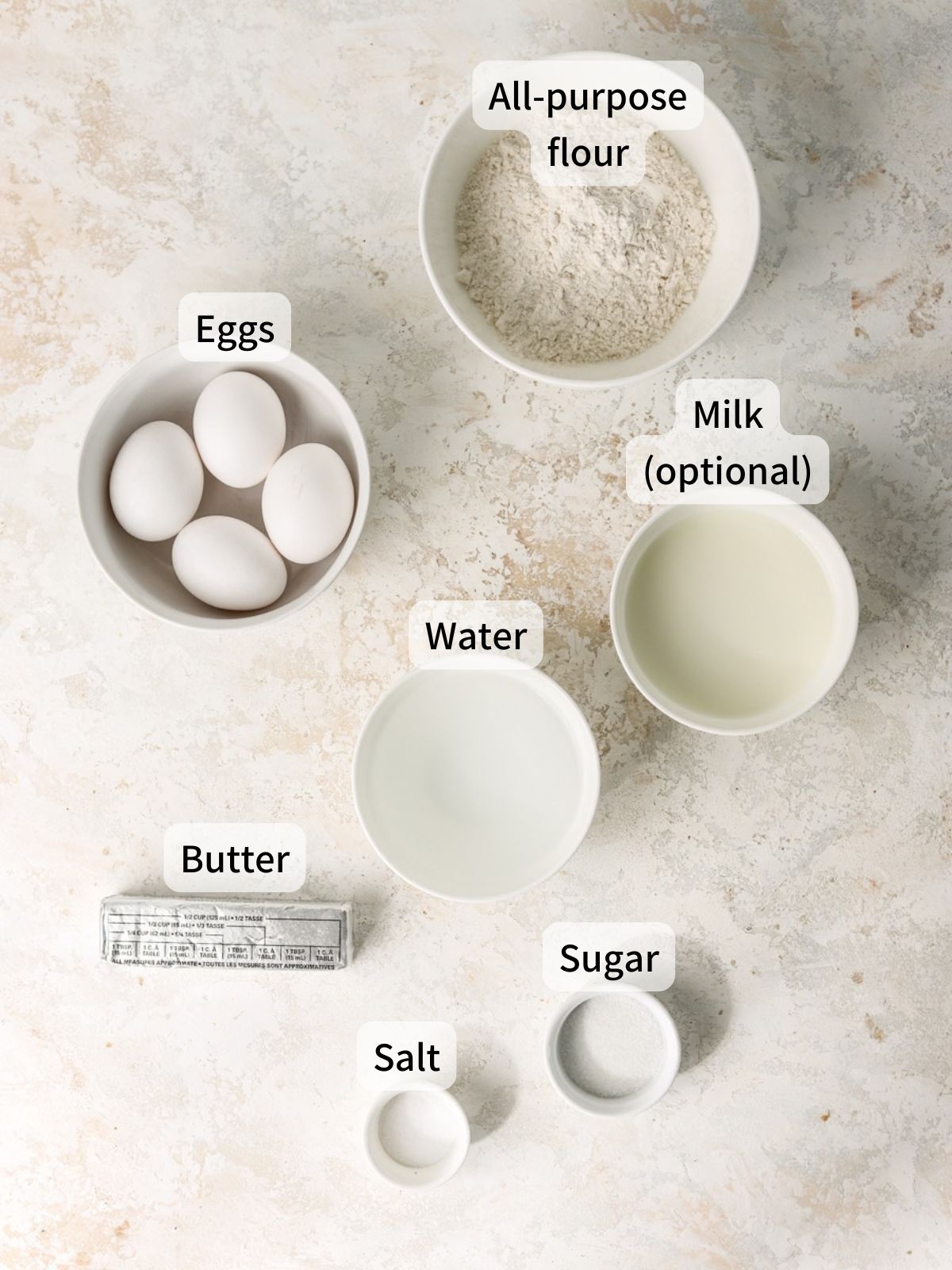
Here are the ingredients you’ll need to make choux pastry:
- You can use water, milk, or a combination of milk and water. I prefer using milk and water. Milk adds extra flavor and using both water and milk makes your choux more smooth on top and helps choux develop more regularly. Using only water will make the choux bake up a little crisper and drier.
- Unsalted butter adds flavor and richness to the dough. Cut the butter into tablespoon sized pieces to help it melt faster.
- All-purpose flour gives the dough structure. I recommend weighing your flour with a kitchen scale and sifting it.
- Sugar: Use caster sugar or granulated sugar.
- Eggs add moisture and structure-they help the choux puff up! Whisk them lightly with a whisk or a fork first so they’re easy to add a little at a time. You may not need to add all the egg the recipe calls for.
- Salt. A little salt balances out and enhances the flavors.
See recipe card below for a full list of ingredients and measurements.
Substitutions and Variations
- Prefer to leave out milk? Swap in water in place of the milk.
- Want a little extra sweetness and crunch? Top your piped choux with pearl sugar nibs or coarse sugar just before baking.
How to Make Choux Pastry
Quick Video Recap
How Do You Make Choux Pastry (Pâte à Choux)
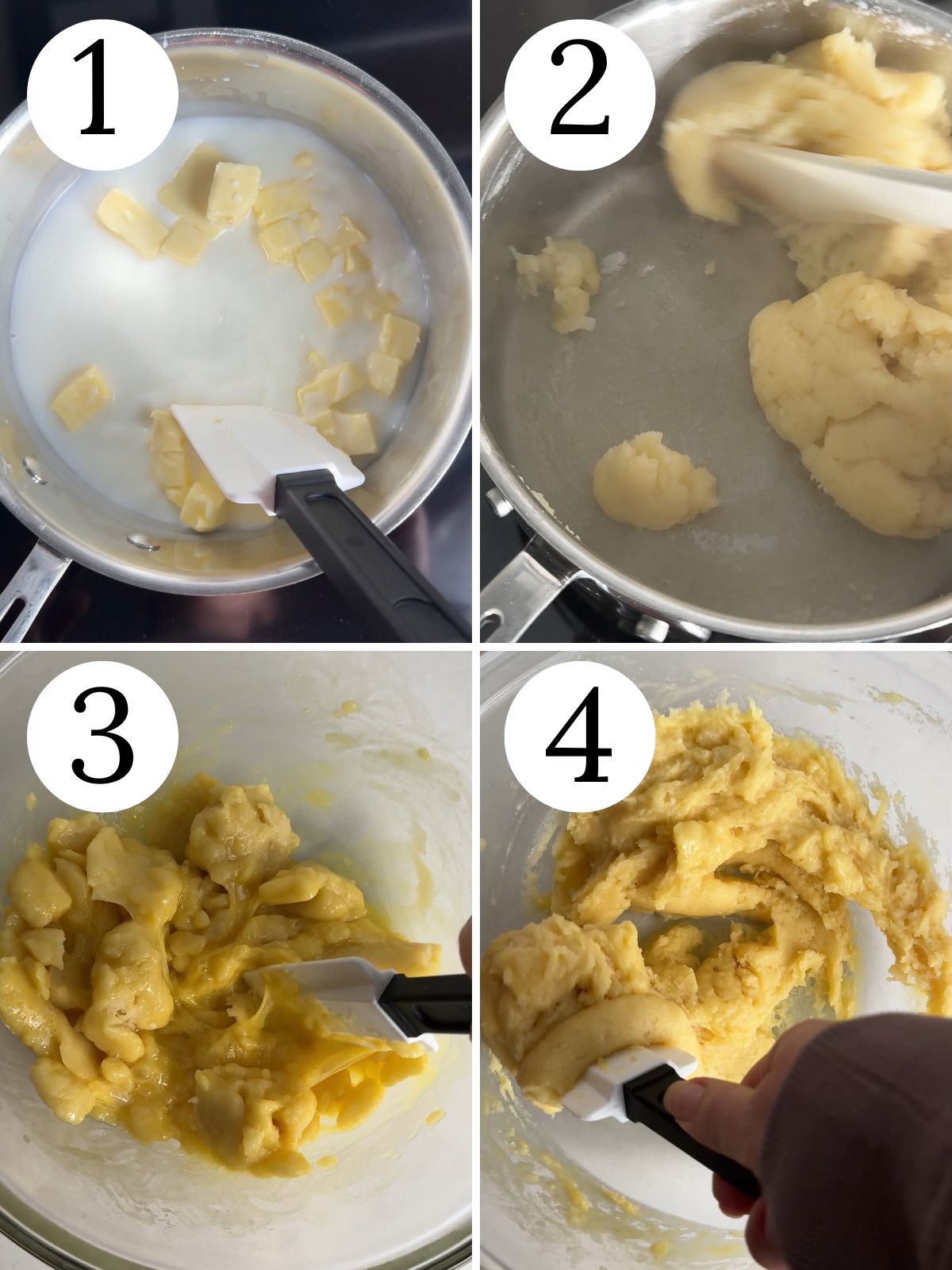
Step 1: Cook the milk, water, chopped butter, sugar and salt together. Stir until the sugar and salt have dissolved and the butter has melted.
Step 2: Bring mixture to a rolling boil. Off the heat, add all the flour. Stir vigorously until there’s no dry flour visible and a paste forms. Return pan to heat. Stir nonstop until the dough pulls away from the sides and a white film forms on the bottom of the pan.
Step 3: Turn dough out into a large bowl. Stir (or mix in a stand mixer fitted with a paddle attachment on low speed) until mixture has cooled slightly. It should only take about 2 minutes of stirring to cool it down. Stir or mix in 50% of the whisked eggs to the dough until completely incorporated. It’s normal for the mixture to look clumpy when you first start stirring in the eggs (see picture 3 above).
Step 4: The mixture will be more cohesive after stirring in the eggs (see picture 4 above). Mix in 50% of the remaining eggs. Mix in another 50% of the remaining eggs.
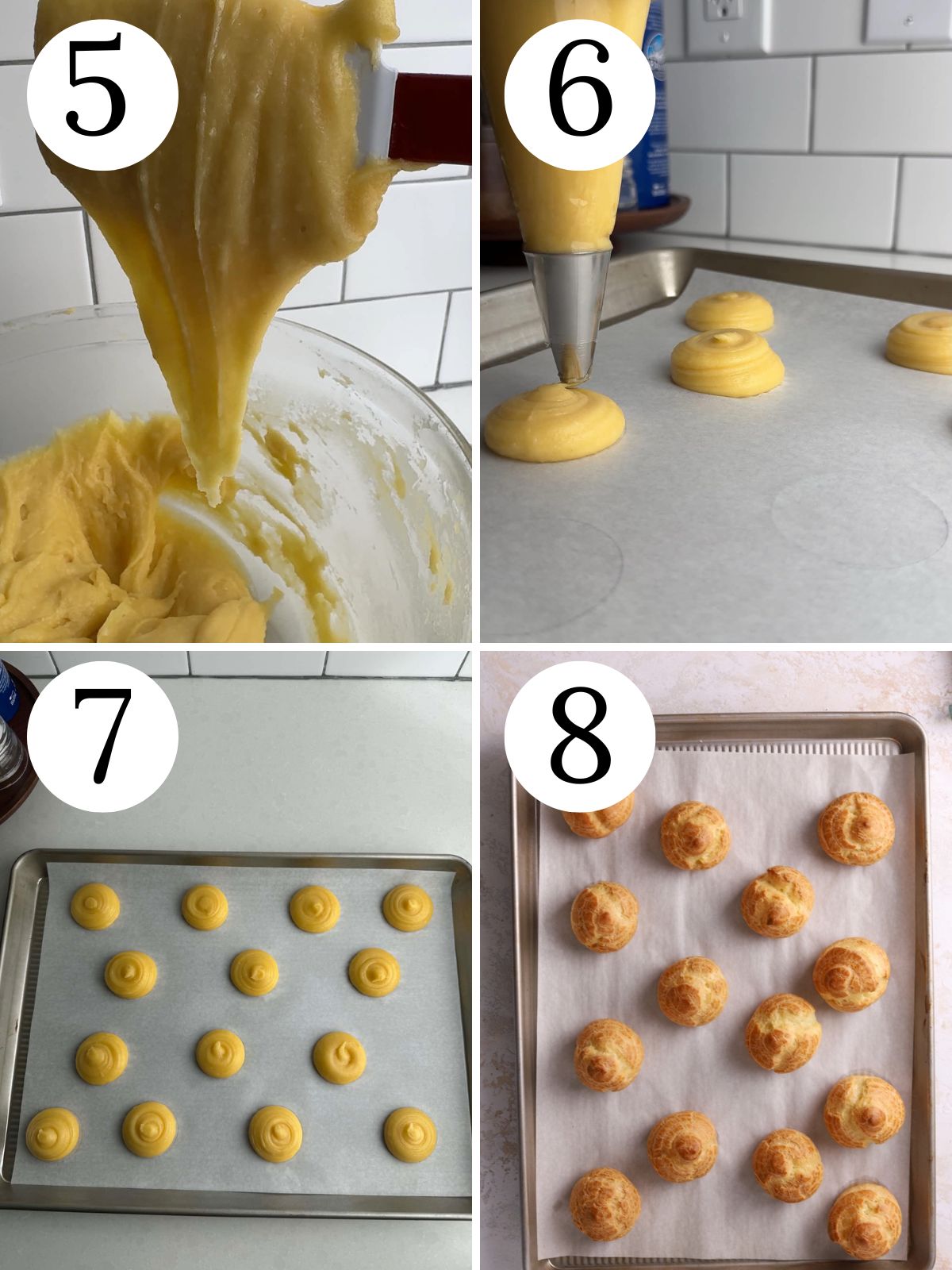
Step 5: Check the consistency before adding more of the eggs. Lift your spatula. Some of the dough should slowly fall off the spatula leaving a “V” shape. If you don’t see the “V” shape, add a little more egg and recheck the consistency. Once you see the “V” and the dough is smooth and glossy, stop adding more egg.
Step 6: Steps 6-8 are instructions for piping and baking cream puffs, but you can pipe this dough into éclairs or other shapes. To pipe cream puffs: hold the bag straight above the tray and don’t move it as you squeeze. Space them about 2 inches apart.
Step 7: Lightly wet your finger and gently press down any peaks.
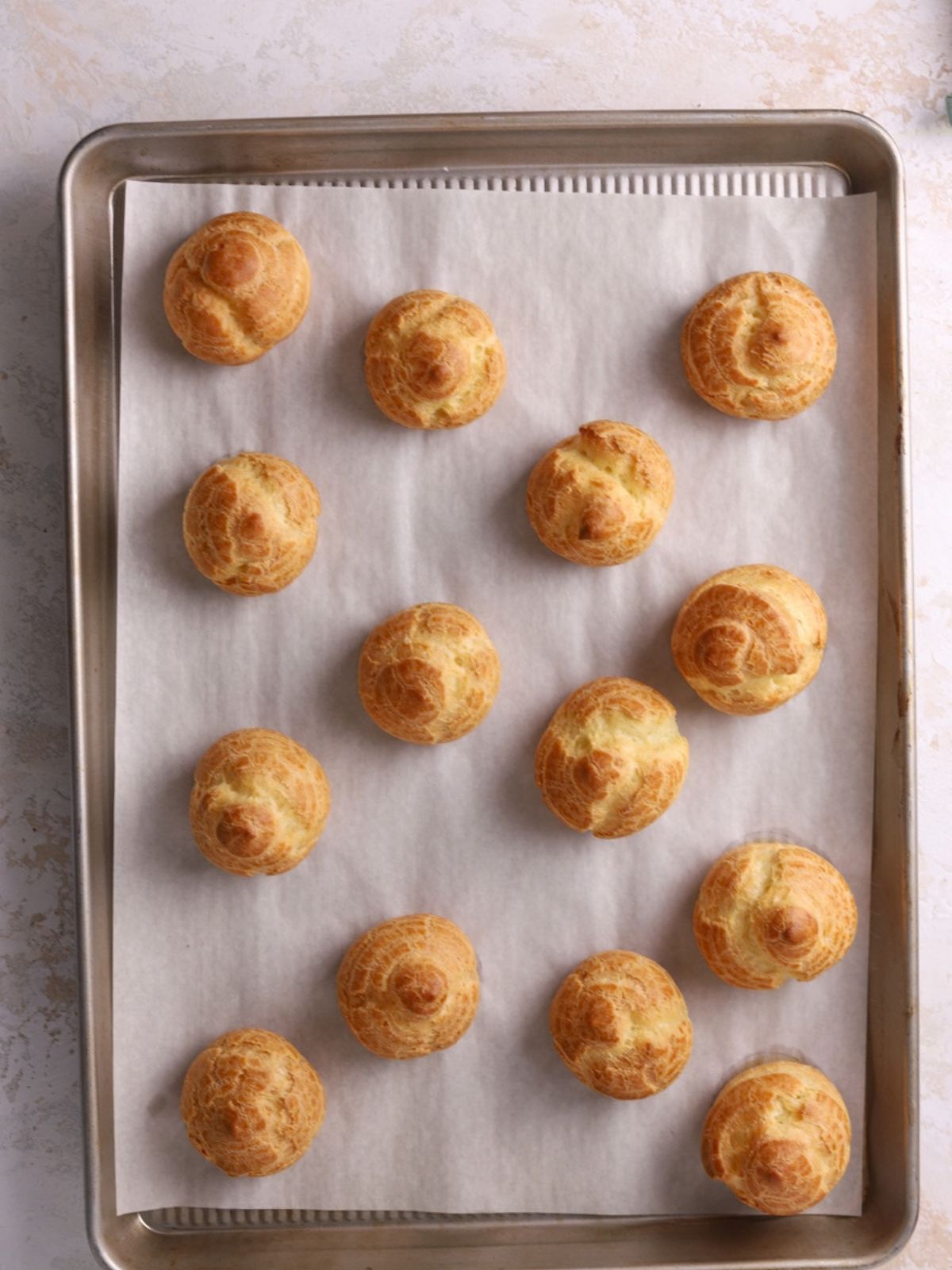
Step 8: Bake in a preheated 375 F oven for 25-35 minutes until puffed up and golden brown and hollow when tapped on the bottom. Don’t open the oven door for the first 20 minutes, since the puffs need steady heat to rise and set their structure, and a drop in temperature can make them collapse.
how to fix choux dough that’s too runny or too thick
The consistency is an important part of this recipe. It should be thick enough to pipe and hold its shape, but not so runny that it spreads after piping.
How to fix runny Choux Pastry
Runny dough usually means the panade wasn’t dried out enough on the stovetop, too much egg, liquid or butter was added, or the flour wasn’t measured accurately.
If the dough is just a little too loose, you can pop the dough in the fridge for about 10 minutes to firm up a little. If it’s very runny, it may not hold its shape even after chilling. In this case, it’s best to start over.
Next time, make sure to measure your ingredients accurately and cook the panade until you see a thin white film on the bottom of the pan.
What to do if choux pastry is too thick
If your dough is still too thick after incorporating all the egg, don’t add more egg than the recipe calls for. Instead, stir in a splash (about 1/2 tablespoon) of water or milk at a time until the dough reaches the right consistency.
Common Choux Mistakes
- Undercooking the dough– Make sure to cook the dough enough after incorporating the flour. Cook it for about 1 minute, stirring constantly. You’ll know you’ve cooked it enough when you see the dough pull away from the sides of the pan and a thin white film forms on the bottom of the pan.
- Adding the eggs while the dough is hot. Transfer the panade to a bowl immediately after cooking. Stir it for a couple minutes before adding the eggs.
- Adding the eggs too quickly. The dough will look clumpy and slippery each time you add some egg. It will come together as you stir it. Wait until the egg is incorporated before adding more.
- Opening the oven door too early. The puffs need that long stretch of steady heat to set. Opening the door can make them collapse.
- Underbaking. Pale shells deflate as they cool. Bake until golden and hollow-sounding when tapped.
Natalie’s Expert Tips
- Read through the recipe before starting. Choux moves fast once the flour goes in, so you’ll want to know what comes next before you begin.
- Measure out the ingredients and take out tools you’ll need before you begin. Having the flour sifted, eggs whisked, and piping bag ready means you can move smoothly from one step to the next.
- Make sure the butter melts and the sugar and salt have dissolved. Cut the butter into small pieces so it melts faster when you add it to the water, milk, sugar and salt mixture. Stir often until the salt and sugar have dissolved and the butter has melted.
- Bring to full rolling boil BEFORE adding the flour. If it doesn’t fully boil, you could end up with a gooey paste instead of a dough that holds its shape.
- Dry out the dough. Cooking the dough after adding the flour removes extra moisture. This will make it easier for the dough to absorb the eggs. The moisture from the eggs turns to steam in the oven and makes the puffs rise!
- Wait a couple minutes for the dough to cool before adding the eggs. You can stir or mix the it for a couple minutes or use a spatula to spread the panade around the sides. Either option will cool the dough enough, so you can add the eggs without scrambling them.
- Add the eggs gradually. Beat in the eggs a little at a time, stopping when the dough is thick, smooth, and glossy. If the dough still seems dry after you’ve added all the egg in the recipe, add a splash of milk or water rather than extra egg. Too much egg makes the dough too loose to hold its shape.
- Leave space when piping. Pipe the dough at least 2 inches apart so heat can circulate and the puffs can expand as they bake.
- Checking for doneness. If, after 30 minutes, the cracks in the choux are not light and not the same color as the crust, rotate the baking sheet and bake 5 more minutes.
Recipe FAQs
There are many options for filling cream puffs, such as pastry cream, whipped cream, chantilly cream, chocolate ganache, chocolate cremeux, jam, and lemon curd. You can also use a savory filling since the shells are mild in flavor and not sweet.
A combination of water and milk is best for choux pastry. It helps it bake up more smooth on top and develop more regularly.
No, choux pastry isn’t hard to make. It sounds fancy, but the dough uses simple ingredients and comes together in minutes. You just need to follow the steps and a few key tips.
Choux pastry dough keeps well, so you can make it ahead. Store it in an airtight container in the fridge for up to 3 days, or freeze it for up to 3 months. Thaw in the fridge before shaping and baking. If you’d like to save a step, refrigerate the dough right in a piping bag so it’s ready to pipe when you are.
Cool baked, unfilled shells completely before storing. Once cooled, store them in an airtight container at room temperature for up to 1 day or freeze for up to 1 month. Refrigerate filled puffs in an airtight container for up to 24 hours. It’s best to fill shells as close to serving as possible.
More Recipes You’ll Love


Did you try this recipe or any other recipe on my website? Please leave a 🌟star rating below and let me know how you enjoyed it in the 📝 comments below.
Don’t forget to tag me on Instagram, Facebook, and Pinterest!
Choux Pastry (Pâte à Choux)
Ingredients
- ½ cup (120 g) water
- ½ cup (120 g) milk or swap in more water
- ½ cup (113 g) unsalted butter cut into 8 tablespoons
- ½ teaspoon (3 g) salt
- 1 teaspoon (4 g) sugar
- 1¼ cups (155 g) all-purpose flour
- 4 (200 g) large eggs
Instructions
- Preheat oven to 375℉.
- Important: Read through the recipe instructions before starting.
- Optional: Trace a piping guide on your parchment so your puffs come out the same size. Cut a sheet of parchment to fit your baking sheet and lay a ruler across the middle. On the half closest to you, use a 2-inch round cutter and a pen or pencil to trace a row of 3 circles along the ruler, leaving at least 2 inches between them. Below that, trace a row of 4 circles staggered in the gaps between the first three. Rotate the sheet 180° and repeat on the other half, for 14 circles in total. Flip the parchment over before using it so you don't pipe onto the ink.
- Line 1-2 baking sheets with parchment paper and set aside.
- Sift the flour over a sheet of parchment paper or bowl. Set the flour close to the stovetop so it's ready to add when needed.
- Use a whisk or fork to lightly whisk the eggs in a medium bowl. Set aside.
- Add the water, milk, sugar, salt, and chopped butter to a medium saucepan over medium heat. Stir often with a spatula until the sugar and salt have dissolved and the butter has melted completely.
- Once the butter has melted, bring the mixture to a rolling boil then remove the pan from the heat. Immediately add all the flour all at once. Use a wooden spoon or sturdy spatula to beat the flour in vigorously for about 15 seconds until no dry flour remains and a smooth, thick paste (called a panade) forms.
- Return the pan to heat and keep stirring until the dough pulls away from the sides of the pan and a thin white film forms on the bottom. This usually takes between 45 seconds to 1 minute.
- Transfer the dough to a large bowl or to the bowl of an electric mixer fitted with a paddle attachment. Stir it with a spatula or mix it on low speed with the stand mixer or hand held mixer for about 2 minutes to help it cool down to approximately 140℉ (60℃).
- Start by adding about half of the beaten eggs into the dough, stirring it in with a sturdy spatula or mix on medium low speed with an electric mixer. Mix well until the egg is completely incorporated. Next, stir or mix in about 50% of the remaining egg then add 50% of the remaining egg. Check the consistency before adding more egg.
- To check the consistency: Lift your spatula (or lift the beaters or paddle), the dough should fall off slowly and leave a thick "V" shape hanging from the spatula (or beaters or paddle). It should be smooth and glossy but thick enough to hold its shape when piped. Stop adding egg as soon as your dough is the right consistency. You may not end up using all the egg.
- Now the dough is ready to be piped and baked. I'm making shells for cream puffs below, but you can pipe the same dough into éclairs, profiteroles, or Paris-Brest. See notes section below on how to pipe this dough for éclairs.
- For cream puffs: Fill a piping bag fitted with a small round nozzle about halfway. (If you don't have a piping bag or nozzle, use a large Ziptop bag and snip a corner).
- Set the baking sheet against the edge of your counter with the long side in front of you. Picture a line running lengthwise across the middle of the tray, splitting it into two halves. Start at the top of the half closest to you, right below the imagined line. Hold the bag straight above the baking sheet, with the tip just above the spot where you want the puff. Don't move the bag while you pipe. Pipe a row of 3 puffs across. Squeeze once until the mound is about 2 inches (5 cm) wide, then stop squeezing and flick the tip to the side to "cut" the dough. Space the mounds about 2 inches apart. Tip: If you didn't trace circles as a guide as described in step 2 above, you can count seconds while you pipe so all your puffs are the same size. Squeeze for about 4 seconds per puff, then stop and lift the bag straight up. Adjust the count to fit your tip size, and keep the same count for every puff!
- Then pipe a row of 4 below it, staggered so each puff sits in the gaps of the row above. Rotate the tray and repeat on the other half. That makes 7 puffs per half, 14 in total.
- Optional- lightly wet your finger with water and gently press down any peaks.
- Bake at 375℉ for 25-35 minutes until puffed up and golden brown. If, after 30 minutes, the cracks are not light and not the same color as the crust, rotate the baking sheet and bake 5 more minutes. Don't open the oven door for the first 20 minutes, since the puffs need steady heat to rise and set their structure, and a drop in temperature can make them collapse. To check that the choux are finished baking, lightly tap on them. They should sound hollow. Slide choux off onto to a wire rack to cool.
- Cool completely before filling. Fill with anything you like! See filling options below in the notes section.
Video
Notes
Nutrition
Please note that nutritional values are created by an online calculator and should only be used as an estimate.

Meagan Smith
Amazing recipe! they turned out awesome.
Natalie Ward
Hi Meagan! Yay I’m so happy your choux turned out so well. Thanks for making it and for coming back to comment!